Here at HydraTough, we’re often asked two key questions by our customers: how are hydraulic power units rated, and what makes one unit better than another? While many assume the answer to these questions comes down to horsepower, pressure or some other figure, the fact is that no single factor provides a definitive answer. Understanding how multiple factors matter – and how they connect with each other – is key to specifying the right solution.
The pump sits at the center of every HPU, and its various ratings set the limits for what the whole machine can achieve. In this learning resource from HydraTough, we break down some of the most important ratings, how they relate to each other, and how you can use them to find the right unit for your site.
How is the Output of a Hydraulic Power Unit Rated?
If you’re asking how is the output of a hydraulic power unit rated, you’re actually asking about three separate yet equally important measurements: flow (GPM), pressure (PSI) and horsepower. Each of these measurements relates to a different part of what the HPU will do on site. In the sections below, we explore each of these ratings and why they matter.
Flow (GPM): How Fast the Work Gets Done
Measured in gallons per minute (GPM), flow governs the speed of your hydraulic power unit. Hydraulic tools will run faster when more fluid reaches them per minute, so a breaker cycles quicker and a wrench will spin up sooner on a unit that provides higher flow. The key is to match the unit’s flow rating to the tools you’re using most often.
This is an important step. Send too little flow and your tools will feel sluggish. Send more than your tools are built for and you risk overspeeding them, which can cause damage and generates excess heat in the hydraulic oil.
Pressure (PSI): How Hard the Unit Can Push
Measured in pounds per square inch (PSI), pressure dictates how much force your hydraulic power unit can apply. With this measurement, a common misunderstanding tends to creep in. Operators often ask themselves: do hydraulic pumps create pressure? The answer catches many people off guard.
A pump creates flow, not pressure. Pressure only appears when that flow meets a form of resistance, such as a cylinder under load or a tool biting into a material. So, when you see a PSI figure on a spec sheet, understand that you’re looking at the maximum pressure that unit is engineered to safely handle once the work ‘pushes back’.
Horsepower: Where Flow and Pressure Meet
Now, let’s take a closer look at horsepower, which brings pressure and flow together. While your unit may deliver strong flow or pressure, its horsepower defines how much of each it can produce at one time without bogging down.
It’s helpful to think of horsepower as the overall budget your engine has to spend. If you spend most of that budget on pressure you’ll have less remaining for flow, and vice versa. That’s why two units with matching horsepower can feel very different once you experience how the power is balanced during application.
How to Calculate Hydraulic Power of a Pump
Once you have a clear understanding of flow and pressure, working out the power of your unit is a straightforward process. The standard formula for how to calculate the hydraulic power of a pump is as follows:
Hydraulic horsepower = (GPM × PSI) ÷ 1714
The 1714 figure in this formula is a fixed constant. It converts the units, so you only need your flow and pressure figures to apply the formula.
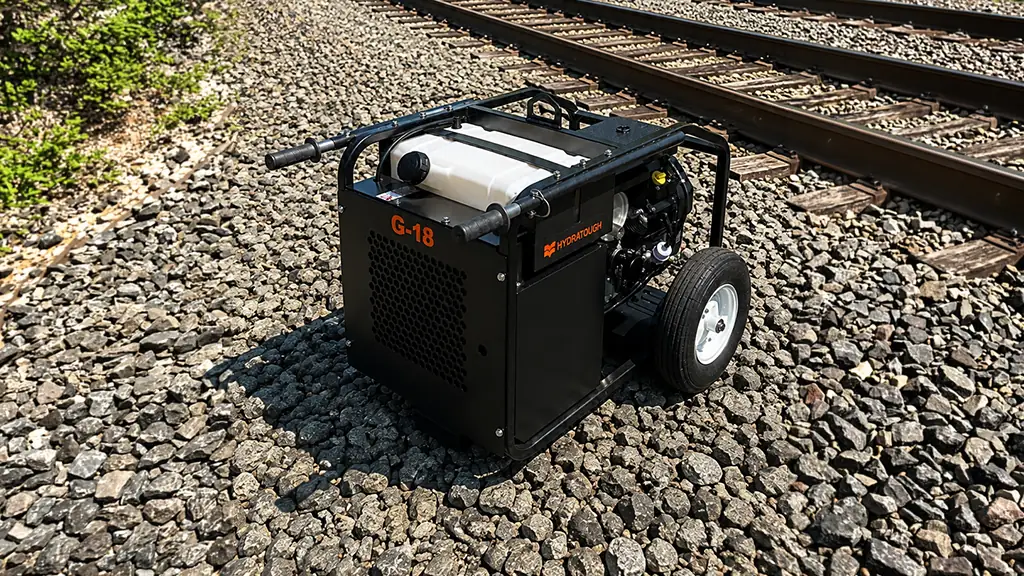
Let’s take the HydraTough G18 as an example, an 18 horsepower gas unit. At a working flow of 8 GPM and 2,000 PSI, the formula gives you about 9.3 hydraulic horsepower. Because no pump is 100% efficient, the engine needs to supply a bit more than that, roughly 11 horsepower once typical pump losses are accounted for. That sits comfortably within what the G18 can deliver, leaving headroom for tougher moments on the job.
For reference, here’s a quick read on any spec sheet:
- GPM dictates how fast your hydraulic tools will run
- PSI determines the maximum force your HPU can hold under load
- Horsepower reflects how much flow and pressure the unit can deliver together
- The gap between rated and actual output comes down to efficiency, so always leave yourself some headroom
What the Ratings Mean for the Job
The key lesson in all of this is that the ratings of your unit are only significant when they match the work they’re being used for. This ensures that your fuel bill is protected. Sizing a unit appropriately for the task at hand keeps its engine working in the range where wastage is minimal, so more of every gallon is driven towards useful, practical application.
- Over-speccing is one of the most common money drains we tend to see. A larger unit than the job requires burns more fuel and presents higher upfront costs, while adding no productivity.
- Under-speccing will cost you in a different way, with slower cycle times and an engine working harder than it has to, shortening its lifespan.
Striking the balance is crucial. This balance can be found with a unit whose flow and pressure comfortably handle your most demanding tool, with a little left in the reserve for the occasional heavier pull.
Beyond the Spec Sheet: What to Look for in a HPU
Units can carry identical flow, pressure and horsepower ratings, but still be worlds apart when it comes to their daily use. Once the figures cover your job, what decides real value is how fast you can get the unit and how easily you can keep it running. It is important to consider these factors as closely as the spec sheet itself, and this is where HydraTough has been built to stand out. Here’s what sets us apart when it comes to specifying your hydraulic power unit:
- All units are in-stock and ship fast across the USA, so your job doesn’t face delays.
- A wide choice of gas and diesel options versus the electric-only route offered by other suppliers
- All units are serviceable in the field, supplied with free manuals and parts diagrams with no account registration required to get them
- Replacement parts are stocked in the US, so your repair doesn’t have to wait on an overseas order
None of these factors show up in a spec sheet, yet all of them will shape how your unit performs across the time you’ll be using it.
Frequently Asked Questions
Do Hydraulic Pumps Create Pressure?
Hydraulic pumps don’t create pressure on their own. A pump moves fluid, which creates flow as a result. Pressure will build when that flow meets resistance such as a cylinder under load. The pump is really the source of flow, and the system around it turns that flow into usable force.
What is a Good GPM for a Hydraulic Power Unit?
There is no single figure here, because the ideal GPM will depend on the tools you run. HydraTough’s advice is to check the flow requirement of your most-used tool and specify a unit that either meets or slightly exceeds it. Please bear in mind that over-speccing above your needs only adds cost and fuel use without adding any additional output.
Is Horsepower the Most Important Rating?
No ratings outrank the others. This is because they work as a combined set. Horsepower sets the upper limit, while flow and pressure determine how that power reaches the tool. Understand how they all work together and size them according to the task you’re working on.
Gas or Diesel: Which Should I Choose?
Your choice between a gas and diesel HPU depends on the task you’re working on. Diesel units are ideal for long, heavy duty cycles, offering better fuel economy and longer engine life. Gas units are lighter, cost less up front, and are the practical choice for more portable jobs.
Get the Right Unit, In Stock and Ready to Work
Every HydraTough unit is built in the USA, backed by a one-year warranty and ready to ship, so you can match the ratings to your job and get the machine on site without the wait, no quote required. Browse the range with specs and prices up front, or reach out to a hydraulic power expert for specialist advice.